
The Vital Role of Greenhouse Gas Accounting
5 min
Oct 2, 2024

By the late 1990s, growing concerns around climate change reached its own ‘social’ tipping point. A coalition of businesses and investors began the initiative to develop a standard approach form the measurement and reporting of data related to GHG emissions for businesses.
GHG accounting has many names — carbon accounting, emissions inventory, emissions accounting, and CO₂ accounting are all common. This can be confusing, but rest assured that they all generally mean the same thing – a method to measure and report the quantity of greenhouse gasses an organization produces (also referred in short-hand climate-lingo as CO₂ or CO₂e).
GHC Accounting
To determine global climate health, scientists measure the total volume of heat absorbing gasses (GHGs) — like carbon dioxide (CO₂) — emitted into the atmosphere. GHGs linger in the air for a long time (think 1,000+ years) resulting in an ever-growing concentration. The more GHGs, the warmer the Earth. The impact of this warming is not linear — we quickly approach a tipping point which risks the permanent disruption of the Earth's capacity to self-regulate surface temperature, a planetary benefit humanity has benefited from for over 9,000 years.
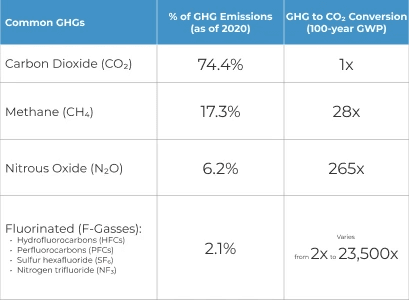
If you see “CO₂e” rather than CO₂, don’t panic. It just means CO₂ “equivalent”. CO₂e provides a common unit to measure global warming regardless of the different gas types involved. A metric ton of any other greenhouse gas can be easily converted into 'equivalent' tons of CO₂ using its respective Global Warming Potential (GWP). CO₂e simplifies top-level reporting. (see chart the below).
Lastly, GHG accounting is not the same thing as GHG detection. Scientists today know how much heat is absorbed by CO₂ molecules. They use these facts to accurately measure the concentration of CO2 in the air.
Unfortunately, the practice of GHG accounting for organizations is less scientific and less accurate…